
| Večer, August 31, 1998 |
![]() Štirje slovenski literarni ustvarjalci, Svetlana Makarovič, Andrej Blatnik, Brane Mozetič in Drago Jančar, so se danes z brniškega letališča odpravili na štirinajstdnevno bralno turnejo po Kolumbiji, Venezueli in Mehiki. Odpravo je pripravil Sklad Vladimirja Bartola s finančnim kritjem Ministrstva ža kulturo in s podporo manjših sponzorjev načeluz Novo Ljubljansko banko, po besedah pripravljalca, Braneta Mozetiča, pa se med soorganizatorje uvrščajo kolumbijska enota mednarodnega PEN, kolumbijsko Društvo pisateljev ter kulturni ministrstvi v Mehiki in Venezueli. Štirje slovenski izbranci bodo dele svojih opusov predstavili z branjem španskih prevodov, gostovali pa bodo v eminentnih kulturnih hramih omenjenih španskoameriških dežel. V kolumbijski Bogoti jih vabijo različne univerze, v Caracasu Centro de Estudios Latinoamericanos RomuloGallegos, ki je osrednja venezuelska kulturna ustanova, mehiško gostovanje pa bo potekalo v muzeju njihovega največjega slikarja Diega Rivera v Mexico Cityju. Brane Mozetič je na naše vprašanje o kriterijih izbora slovenskih predstavnikov na turneji povedal, da med slovenskimi avtorji še zdaleč ni opaziti kakšnega navdušenja za potovanja v tujino, merila pa so: generacijska in spolna raznolikost, prisotnost španskih prevodov, prosti termini avtorjev in že omenjena nemobilnost, nezanimanje avtorjev. Sklad Vladimirja Bartola se s pomočjo Ministrstva za kulturo trudi pripravljati predstavitve slovenske literarne produkcije v tujini, ponavadi pa obiske tujih držav povežejo z izidom prevodnih publikacij.Tokrat so izdali šestdesetstransko knjižico španskih prevodov del SvetlaneMakarovič, Andreja Blatnika, Braneta Mozetiča in Draga Jančarja. V zadnjih petih letih so slovenski literati obiskali še Madrid, Belgijo, Francijo in Združene države Amerike. uč
|
| Últimad el tiempo, September 2, 1998 |
|
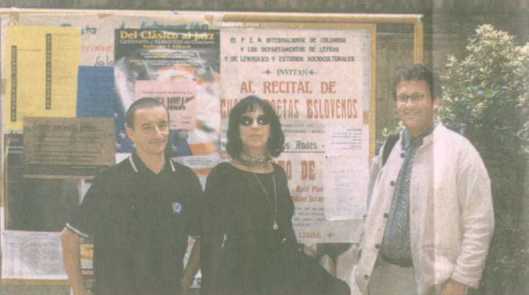
El evento se iniciará a las 12 m. y estará a cargo deuna delegación de escritores de ese país. Los escritores, invitados por la organización mundial Poetas,Ensayistas y Narradores, PEN Internacional, serán Marko Jensterle, SvetlanaMakarovic, Andrej Blatnik, Brane Mozetic y Drago Jancar. Las personas interesados en tener mayor información delevento pueden comunicarse a los teléfonos 2849911, 3520466 y 2869211, en los departamentos de Letras y Lenguaje, y Estudios Socioculturales dela Universidad de Los Andes. |
| El Universal, September 2, 1998 |
![]() Caracas.- Una muestra de literatura eslovaca presentará estesábado la Dirección de Literatura del Consejo Nacionalde la Cultura(Conac), la cualestará integrada por Svetlana Makarovic, Andrej Blatnik,Brane Mozetic y Drago Jancar, con obras que danzan entre la poesía y laprosa, con visiones particulares y diferentes. Estos cuatro autores compartirán sus experiencias y trabajoscon críticos literarios y otros escritores en el Centrode Estudios LatinoamericanosRómulo Gallegos (Celarg). Dentro de esteencuentro se podrá pasear porlos poemas neoexpresionistas, salpicadospor motivos populares de Makarovic,la metaflcción que encierra laobra de Blatnik, a la vez que se enlazacon cada proyecto de Mozetic, asícomo se podrá ver la novelística,íntima y emocionalobra de Jancar. Este encuentro anormal para el público caraqueño, servirácomo aproximación a una literatura poco conocida enel pais, ya que luegode la reforma Europea suscitada a raíz de loscambios socio-políticosde la última década, los intercambios culturales han sido inconsistentes,lo cual ha ido cambiando en los últimos años, aunque no se ha logradola estabilización del conocimiento necesario de estas obras para una efectivadivulgación. Esta convergencia literaria reafirma lazos de amistad entreambos pueblos, asf como el intercambio artístico entre las naciones, locual genera una mayor amplitud de estilos. |
| Economia Hoy, September 4, 1998 |
![]() Cuatro escritores de la república centroeuropea (Eslovenia), entreellos Drago Jancar, el más importante novelista viviente de ese país,llegan a Venezuela para intercambiar con el público mañana sábado alas 5:00 pm en la sala D de la Casa de Rómulo Gallegos, ubicada en laavenida Luis Roche dc Altamira. La delegación está integrada también por Svetlana Makarovic,Brane Mozetic y Andrei Blatnik. La gira de estos autores forma parte deuna iniciativa del ministerio esloveno de Cultura, y en Venezuela cuentacon el apoyo del Consejo Nacional de la Cultura, a través de la Direcciónde Literatura, courdinada por Juan Carlos Santaella. Los escritores vienen de Colombia y de Venezuela seguirán a México. El coordinador de la gira es Marko Jensterle deíMinisteriode Cultura de Eslovenia, la intérprete será MarietaDrobnic y la coordinadorade Logística en Venezuela es Karolina Koglot,mientrasque la coordinadorade esta actividad por parte det Conac es LauraNazoa. La historia de la literatura eslovena es una perrnanente lucha por conservar su identidad frente a las agresiones externas y ladivisión territorial; de ahí que Eslovenia haya dado eminentes filólogos. Uno de ellos, Jernej Kopitar, publicó en 1808 la primera gran eslovena. Especial/Economía Hoy
![]() |
| El Universal, September 5, 1998 |
![]() Svetlana Makarovic, Andrej Blatnik, Brane Mozetic y Drago Jancar estaráneste sábado 5 de septiembre en el Celarg, a las 5:00 pm, para un encuentrocon el público. |
| Delo, Književni listi, September 10, 1998 |
|
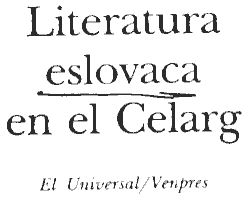
Med inštitucijami, ki so se ob pravkar potekajoči bralniturneji SvetlaneMakarovič, Andreja Blatnika, Draga Jančarja in Braneta MozetičapoLatinski Ameriki še posebej angažirale, je bilotudivenezuelsko ministrstvoza kulturo. Tam niso poskrbeli le za to, da sov sobotonaši literatisvoja dela brali v elitnem Centru za latinskoameriškeštudije RomuloGallegos, ampak so že dober teden pred njihovim prihodomv Caracas medijemrazdelili osnovne informacije o dogodku. Med mediji je bila najhitrejša tiskovna agencija Venpress,kije v svojem poročilu najavila dogodek, toda v naglici je bralce povabilana predstavitev »slovaške literature«. Članek s to napako so v sredo ponatisnili v dnevniku El Universal, toda na takojšnjo intervencijo iz slovenskega kulturnaga ministrstva pri omenjeni agenciji so že naslednji dan v poročilih agencije in v ElUniversalu objavili popravek inbralce obvestili o predstavitvi »slovenske literature«. Da pa bi se za neljubi dogodek še dodatno oddolžili, so popravek dopolnili s podatkom, da pisatelji prihajajo iz tiste državeki jo je pred leti v Venezueli s svojo Divino Comedio že zastopal. Tomaž Pandur, ki je tedaj osvojil srca venezuelskih ljubiteljev gledališča, zdaj pa njegovo pot nadaljujejo še literati. M. J. |
| Delo, September 24, 1998 | ||
![]() Sklad Vladimirja Bartola se že vrsto let trudi s promocijo slovenske literature v tujini. Po prvih navezovanjih stikov, ki so obrodili razne revijalne objave, so sledile knjižne publikacije, vselej pospremljene tudi z živo predstavitvijo avtorjev. Tako imenovane bralne turneje, kijih pozna vsak uveljavljeni tuji pisec, so potekale že v Franciji, Belgiji, Španiji in lani v ZDA. Letošnji cilj so bile dežele Latinske Amerike: Kolumbija, Venezuela in Mehika. Pa ne zaradi njihovih žajfastih nadaljevank.Bolj zaradi njihovega navdušenja nad slovenskim gledališčem in popolnega nepoznavanja slovenske literature. Prva dva tedna v septembru smo SvetlanaMakarovič, Drago Jančar, Andrej Blatnik in Brane Mozetič, otovorjeni z drobno predstavitveno knjižico v španščini Cuatro autores eslovenos,pripravili pet branj. Seveda ob pomoči Jasmine Markič, ki je poskrbela za uvod in lažjo komunikacijo. BOGOTA, šestmilijonsko mesto velikanskih razlik, s številnimi univerzami, se je izkazala tudi kot najbolj gostoljubno mesto - vsaj glede gostiteljev. Ali pa zato, ker je šlo predvsem za pisateIjice. Nina de Friedemann, predsednica kolumbijskega društva pisateljev, nas je uvedla na (bolj katoliški) univerzi Javeriana. Dr. Cecilia Balcazar de Bucher, predsednica Pena, pa takoj naslednji dan na Universidadde los Andes. Najavav obeh osrednjih časopisih je privabila med 50 in 60 poslušalcev, ki so po branju zastavljali tipična vprašanja o skoraj neznani deželi in kulturi, še bolj pa jih je zanimala temačnost predstavljene poezije. Morda tudi zato, ker Latinoameričani, kljub nasilni zgodovini, niso tako mračno razpoloženi, še manj pa samodestruktivni. Branje na državni Nacionalni univerzi je bilo namenjeno študentom in je potekalo najbolj sproščeno, morda tudi zaradi gostitelja prof. Diogenesa Fajarda, ki mu Slovenija ni več neznanka, saj je že predaval na Ijubljanski FF. Žal nam je lahko samo, da nismo brali v Casa de Poesia Silva (Jose Asuncion Silva je največji kolumbijski pesnik), ki je prav zgleden center poezije in pesniških srečanj cele Latinske Amerike. Knjižnica, fonoteka, videoteka, prodajalna, prostor za prireditve, vse zelo toplo in domače, v ne dosti večji hiši kot je hiša slovenskega društva pisateljev in Pena. CARACAS, prav tako veliko, a dosti sodobnejše mesto. Nismo več na triglavski višini in ozračje je manj napeto. Medtem ko se Bogota duši v prometu in kriminalu (lokale zaprejo ob enih zjutraj), lahko tu posedaš na ulici do ranega jutra. Menda se že dolgo bolj zanimajo za trgovino kot za kulturo. Branje je bilo v soboto, ob petih popoldne, v zelo uglednem Centro de Estudios Latinoamericanos Romulo Gallegos, ki je kot nekakšen Cankarjev dom. Najav našega branja je bilo zelo veliko, že nekaj dni prej, tudi v mesečnem programu centra in organizatorji sonatisnili posebna vabila. Naša gostitelja sta bila Juan Carlos Santaella, zadolžen za literaturo pri njihovem državnem svetu za kulturo, tudi sam pisatelj, in pa slovenska slikarka Karolina Koglot, ki že vrsto let živi v Venezueli. Občinstvo je bilo izbrano, a ne več kot 40 poslušalcev. Morda je bil kriv tudi dogodek sezone, konceri Rickyja Martina, ki je hkrati potekal na osrednjem stadionu. Ali pa je tak obisk nekaj običajnega, saj tudi dvorana, v kateri smo brali, ni bila posebno velika. Prišlo pa je nekaj novinarjev. MEXICO CITY, nepregledno, dvaindvajsetmilijonsko mesto, višina, slab zrak. A že na letališču sam Gabriel García Márquez. Kot eden od potnikov, seveda. Ki pa je dosti hitreje prestopil vse carinskeovire kot mi. Organizacija branja v Mehiki je potekala z njihovega ministrstva za kulturo navzdol in se očitno nekje izgubila v birokratski površnosti. Edino tu organizatorja ni bilo na letališče, pa tudi pred samo predstavitvijo se ni pojavil. Lokacija je bila sicer izvrstna, Museo Mural Diego Ri!vera, v samem centru mesta. Toda ko smo prispeli tja, zaradi nenadnega naliva z manjšo zamudo, tam ni bilo tako rekoč nikogar. Končna organizatorica je tja poslala svojo odposlanko, ki ni kaj dosti vedela, tam pa sta se znašla še stari Ijubitelj Slovenije, novinar John Maxim, in pa mehiška ustvarjalka Gabriela Moya, sicer pomočnica znanega pisatelja Edgarda Bermeja, ki sta za branje zvedela še iz Slovenije. Tudi na samem vhodu ni bilo niti lističa s kakšno najavo. Branje je tako odpadlo in tudi naslednje dni se ni za to nihče opravičil. Slab občutek pa je popravila Gabriela,ki je že poprej skušala izpeljati še dodatno branje v Casa del Poeta.Tako pot v Mehiko ni bila zaman. Naslednji večer, v petek, 11. 9. smo opravili pogovor za mestno TV Canal 22 ter brali mehiškim kolegomv Casadel Poeta. Za objavo smo se dogovorili kar s tremi tamkajšnjimi revijami oziroma časopisi. Da pa bi odnesli tudi kaj s seboj, smo se razgledali še malce naokoli, zaradi malo časa ne prav daleč od prestolnic: od solne katedrale v Guatavita pri Bogoti do piramid Teotihuacana pri Mexicu,če ne omenjam skoraj neokrnjenega karibskega arhipelaga Los Roques. LJUBLJANA, hladno in deževno vreme. In kmalu klic Marka Jenšterleta, ki je bil povezovalna nit pri pripravi cele turneje. Nato poročila Ministrstvu za kulturo, ki je omogočilo potovanje, z zadržki sicer. Verjetno bo počasi marsikomu postalo bolj jasno, da so take predstavitve zgolj investicije za naprej.
|


![]() |
Andrej Blatnik (Ljubljana, 1963) es considerado
el iniciador de la prosajoven eslovena. Su obra perfiló en muchossentidos
las características esencialesde la metaficción eslovenacon-temporánea.
Es autor de la primera, y hastaahora única,nove-la eslovena de metaficción:
Plamenice in solze (Antorchasy lágrimas).Sus relatos breves se distinguen
por la perfección estilística,el articifio literario, el dominio
del género, la fragmentación,la imitación,la ironía,
la parodia, la ridiculización,etc. Quizá la caraterística
másimportante de su prosacorta sea la ausencia del sentido clásico.
Esta característicapuede estar relacionada con el minimalismo de Blatnik.
El tema de sus relatoses la cotidianidad sin importancia, el momento, el
acto huidizo que no esprotagonista fuera de la literatura y no tiene nada
en común con losgrandestemas de la metafísica. En este caso
no se trata de una reducciónforzada,sino de un gesto acorde con el
espíritu de nuestro tiempoque está cada vezmás atento
a lo periférico y que noestablece una diferencia vatorativa entrelo
grande y lo pequeño. |

![]() |
|
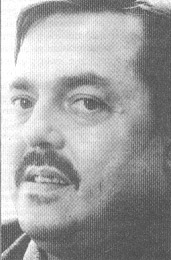
Drago Jancar (1948) es considerado
por la crítica eslovenacomo el narrador contem- poráneo más
influyente. Su evtensa obra ha sido traducida a varios idiomas.
|
| Mexico City Times, September 29, 1998 | |||||
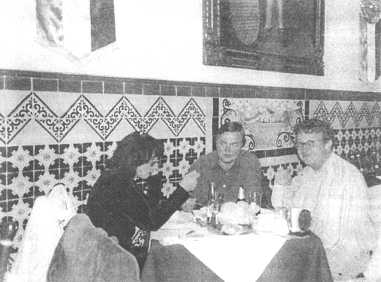
![]() ![]() ![]() It was a dark and stormy night recently, and the traffic was horrendous. With more than 20 million people and almost 3 million vehicles, MexicoCity, the world's largest, most exciting and colorful urban sprawl, inan evening rush hour during a thunderstorm became one big monumental trafficjam. That was especially true in the downtown Historic City Center areawhose streets were designed centuries ago for horses, carriages and a fewthousand pedestrians. As a result, I was a half-hour late for a literary event. Four authorsfrom Slovenia, winding up a Latin American reading tour thathad takenthem to Santa Fe de Bogota, Colombia, and Caracas, Venezuela, hadcometo Mexico City to read from and promote their works in Spanish translations. Sponsored by the National Institute of Fine Arts (Bellas Artes, as it'sknown), they were to appear at the Museum of the Diego Rivera Mural, whichhouses"Sunday in Alameda Park," one of Rivera's satirical masterpieces,at 7 pm.When I arrived by taxi at 7:30 pm, the Slovene authors were gatheredat theentrance and getting ready to leave. Upon introducing myself, Iasked them "Why?" "Because nobody came," one of them replied in English. "Bellas Artesapparently did not promote or publicize our visit at all. How did you findout about it?" "I got a letter from Slovenia's Ministry of Cultureabout it a monthago," I said. "Well, you're the only person who showed up:" Shocked, empathetic and embarrassed for them and for Bellas Artes,I apologized for being late, I apologized for their non-reception in Mexico,I apologized for Bellas Artes, I even apologized for the rain. I had visited their country in 1991, the year Slovenia won its independence,after a brief war with the Serbian Federal Army, from the former Yugoslavia,and had been treated royally. As a foreign correspondent covering both the brutalSerbian destructionof a defenseless Croatian town called Vukovar for a Mexicannews agencyand simultaneously covering a superb three-week Slovene TheatreFestivalin Maribor as an arts critic for a Mexican newspaper, I had alsomet Slovenia'sPresident, Milan Kucan, since reelected, who is leading hisemerging countryof 2 million into the modern world where it will soon becomea member ofthe European Union, with its new Euro-currency and all. Having gained great respect and admiration for the tíny nation, itspeople, their hospitality and high culture, which has not yetbeen dumbed-downthrough mainly US pop mass-cult influence into Kulture (withacapitalK for Kitsch); I decided to try and reciprocate the warm hospitalityIhad been shown in their country on the sunny side of the Alps by figurativelyshowing them the sunnier side of Mexico on a rainy night. "What," I asked them, "do four brave Slovene authors do when they havecome halfway around the planet to offer readings in Mexico City, had theirliterary event rained out and ignored by the communications media, feeldepressed and don't know what to do?" They looked at me with question marks. "Well," I said, "they go out on the town and have awonderful time!Follow me, please..." I decided to take the group of seven to dinner and led them on an impromptuguided walking tour: Along Avenida Juarez, brightly lit with patrioticred, white and green light displays celebrating Mexico's Independence Day;pasr the Juarez monument in Alameda Park, the Westerri Hemisphere's oldest; into the marble Art Deco lobby of the Palace of Fine Arts, filling withpeople at showtime, to see the Tamayo and Siqueiros murals; past the mainpost office building with its faux-Venetian Doges Palace facade and interiorwrought-iron grills and staircase made in Italy; past Manuel Tolsa's superb Carlos IV equestrian statue in thc plaza in front of the National Museumof Art, with his colonial Palace of Mining building across the street; pasr the latter's entrance which displays authentic particles of stardust from outer space four huge, heavy metal meteorites that had fallen on Mexicanterritory; then through the drizzle up narrow Calle Tacuba, congested withcars and frustrated drivers furiously blasting their homs; and finallyinto the foyer of one of Mexico's best traditional restaurants, the Cafede Tacuba. There, without a reservation at hectic pre-showtime, our party of eightmattaged to get two tables for four in the middle of the room as they becamevacant. For two hours, they wined and dined. They loved the Mexican food,the bustling, brightly lit atmosphere, and the strolling "estudiantil"musicians who, dressed in Spanish colonial costumes, serenaded the dinerswith mandolins, guitars and songs well into dessert and coffee. But seatedas I was with a poetess and two authors, the real entree was literary shop-talk and gossip atourtable. The Slovenes expressed a desire to see and hear theworld-renownedmusic of mariachis, so after I picked up the tabs for bothtables, theguided tour, then consisting of only five hard-core adventurers(threeothers retired after the late dinner) continued. Outside, the heavy, horn-honking traffic and rain had miraculouslyvanished, it was pleasantly chilly, and a brilliant full moon played hide-andseekwith wispy cotton-candy clouds in a cobalt blue sky. The city center hadbecome a quiet village. As we strolled through some alrnost desected dark wet streets, pastyoung lovers discreetly spooning in unlit doorways, througha small bandof boisterous teena ers la in soccer in their neighborhood street, pastsmall bars and eateries, one of the Slovenes asked, "Is it safe to walk like this through these dark streets?" "Yes," I replied," as safe as it is in your capitalof Ljubljana. Itdepends on whom you're with and how you behave." After a half-hour walk that was good for the digestion, we turned acorner and entered another world, the unique one of Plaza Garibaldi orMariachilarid. Brightly illuminated with many yellow sodium street lamps and garish neon signs announcing bars, discos and restaurants surrounding it, the Large open square was filled with hundreds of people milling about and dozens of mariachi groups standing around waiting for business - tobe hired to entertain - or playing and singing different songs simultaneously. As we walked around listening to the various groups, fending off politesolicitations and offers of tequila in styrofoam cups from vendors, anddodging odd, mostly inebriated characters, the place worked its magic spellon the Slovenes. They found it fascinating, utterly. When it started to drizzle lightly, we sought refuge in the most famouscantina on the square, the Tenampa, which wasn't too crowded. As we settledinto a large booth in the fairly small room, a big mariachigroup of about16 handsomely dressed musicians were serenading a large tableof middle-classMexican customers. Some of them, fairly well into their cupsbefore midnight,sangalong and got up to dance to the catchy folkloric rhythms,weavingabout andemitting loud "Ay-ay-ay!" shouts after appropriate lyrics. I ordered a large bottle of the house specialty, Pomegranate. Punchfrom Guadalajara which was served with little brown paper bags of peeled walnut. "For the vitamin C," the waiter said and for the next hour, weemptied the bottle. The red punch tastes like a sc drink, but it has adelayed kicker, like the plum brandy national drink of the country, I hadwamed them. "This is the real Mexico," one of the Slovenes blinked as they sathappily spellbound by the mariachis and ct tomer antics untila bit pastmidnight. We left the Tenampa just as the place began to fill and reallycome to life. After another brief, bracing stroll through the plaza and a visit tothe on-site food market with its many small restaurants, music and temptingaromas, I led them a few blocks down Eje Lazaro Cardenas street along whichmany mariachi musicians were passing out business cars and soliciting businessfrom passing cars. "It's amazing," one of the Slovenes said. "A11 these people and nota single policeman!" "Oh, they're probably around, keeping peace in and around Plaza Garibaldi,but they're in plainclothes rather than uniforms," I explained. By one o'clock in the morning when I safely deposited them in the lobbyof the Hotel Metropol, they thanked me for the dinner, the drinks and theguided night tour and the sights and sounds that few tourists ever see.I thanked them for the pleasure of their company and their spo~ing attitudes,arranging to see the ~ the next day. My mission that memorable night had been accomplished: The Sloveneauthors had completely forgotten about their cancelled literary event.
|
| El Impulso Literaria, October 18, 1998 |
![]()
La setección fue tomada de CUATRO ESCRITORES ESLOVENOS(1998),impreso en ocasión de la visita de los autores eslovenos a AméricaLatina, con prólogo y notas de Marko Jensterle, Jefe de Gabinete del Ministeriode Cultura de uno de los países más jóvenes de Europa - se independizóen 1991-, situado entre Austria, Italia, Hungría y Croacia. Una buenarepresentación de la literatura lafinoamericana ,incluyendo al PopolVuh y venezolanos como Rómulo Gallegos, Rufino Blanco Fombona,Julío Garmendia, Héctor Mujica y Arturo Uslar Pietri, además detrabajos críticos sobre nuestros autores, ha sido traducida desde haceseis años, lo cual no resulta tan sorprendente, si consideramos que apesar de contar con sólo dos millones de habitantes, Eslovenia tiene másde 150 editorialesque publican anualmente 2.500 libros. Marisela Gonzalo Febres
SVETLANA MAKAROVIC(1939), poeta y narradora, ha publicado varios libros: El Crepúsculo (1964),Nochede San Juan (1968), Fresas Lobunas (1972), La Nierba Buena(1973), Mujer Ajenjo (1974), Tiempo de Guerra (1974),Sustracción(1997) Poesías (1979), El Vecino Montaña (1980); Poesíassobre Eslovenia para huéspedes dol país y extranjeros (1985), ElCrisantemo sobre el piano (1990) Aguel Tiempo (1993) y Cuéntame algo lindo (1993). Su poesía es de "color oscuro, sombría y grave,donde la muerte es más fuerte que el amor" Esta poetisa trabaja con losmotivos populares reintepretados de manera contemporánea: "... elige parasu punto de partida de expresión y estilo, la tradición oral eslovena,se enreda en la experiencia trágica del mundo". Un mundo cerrado, atemporaly autosu ficiente. BRANE MOZETIC Toda traducción es "traición" y siempre tendráen contra cierta pérdida de ritmo y de significaciones inherentes a lalengua en que se pensaron y escribieron los poemas.Quizás más que "entender"ciertas claves de lectura,los lectores terminamos por "intuirlas".

LA MAÑANA Caminas cuidadosamente entre los trozos del sueño Tímidamente sorbes plata Las caras grises de la noche gris Anda con cuidado. LA CAZA Hueles a semilla caliente, ciervo. MALEFICIO Te llamo, te convoco, meleficio, ESPEJO Abre los ojos, despierta en el acto. Siente sus propias ajenas manos sudorosas Y recuerda que se encuentra en casa ajena,
I los hechiceros silenciosos de las metrópolis tienen el poder
II tengo miedo del amor contigo, sabes demasiado rápido clavas una herida, dices tengo miedo al andar por la ciudad de que el río se derrame, caiga III la noche avanzada, cuando no lo notas, me IV cada vez más vida aumenta el dolor |