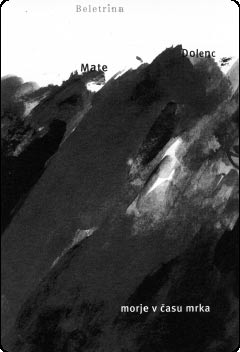
Mate Dolenc
Morje v času mrka
Študentska založba 2000
Mate Dolenc (b. 1945) is a writer of satirical and fantastic novels and short stories, as well as a deep-sea diver and fisherman. A real blockbuster in Slovenia was his travel journal in the form of short stories, describing his experiences of different seas all around the world, though most of all his beloved Adriatic - a sea dotted with a thousand islands, or as he calls it "the constellation of the Adriatic" (1998). An Adriatic archipelago is also the setting of his novel The Sea at the Time of the Eclipse (2000): The Dalmatian island Biševo, with a blue cave basking in emerald light, part miracle part real. Old Sebald's story is both miraculous and real: Diving in the unfathomable Depth and Distance of the sea, time and love. The sea, which forever keeps changing and remains the same, is like time, which flies and stands still; and both are like love, which calls from the past and kindles the flames of the present: Ivana comes to settle on the island, a girl who rejuvenates Sebald's old age and lets herself be transformed into a mermaid, a seal from the enchanting blue cave. Will the old man manage to catch his fish at the time of the eclipse? Will he be able to return alive from the depths? Will he know how to sail into death with love?
Vanesa Matajc
Vanesa Matajc is the Winner of the Best Young Critic ("Stritar") Award.
Translated by Tamara Soban.
Published for the Slovenian presentation at the Frankfurt Book Fair,
October 2002, by the Center for Slovenian Literature.
The pasara (excerpt)
"Miloš's dead." The news made the rounds of the island, traveling from
hilltop to hilltop, from valley to valley, from headland to headland, from
kitchen to
kitchen, from boat to boat, from ear to ear, from heart to heart. Death
on the island. For someone, the sea had died. For someone, sunrise had
been extinguished,
and he had been engulfed by sundown. For someone, the vineyards had
perished, and all the fish.For someone, the island had died; for everyone
else, a part
of the island.For Miloš, Dina had died; for Dina, Miloš. The island's
phones kept ringing, those with cords and those without, CB stations and
cell phones
competed with calls shouted from one hilltop to the next; only a few
years earlier such shouts had been the only means of long-distance communication,
and women
in particular had unusually strong voices which carried, cutting a
gash through the air for miles, like sharp wire. Many of them still pass
on messages in this
fashion today. The tidings of the death came quickly, one hour after
the arrival of the regular ferry. Every piece of information always spreads
around the island
like wildfire, leaping from tree to tree, from rock to rock, from vale
to vale, flowing over saddles and ridges, reaching the remotest and loneliest
of houses
in the shortest possible time. Also, the bell in the head of the white
woman on top of the island, next to Miloš's house, tolled. Miloš's son-in-law,
who
had caught the early morning ferry to the island and gone in search
of Miloš when he had failed to return home by nine a.m., pulled on its
thick rope. Dina's
wails were incorporated into the bell's tolls. Foka immediately took
the ferry back to the big island to fetch the doctor and the priest. The
former is here
called dotur, the latter fra.
Several men went to get Miloš. Because of the steep incline in the
road they could not transport him any other way than on Kenja's back.
Also picigamorti
came back with him, the black bream, his first companions. They were
carefully stored in the icebox.
The kitchen was cleared and tidied up, the table pushed to the side,
the couch placed in the center and Miloš laid on it, the shutters closed,
and the candles
lit. Night fell inside the house, while outdoors daylight shone bright.
A day without a cloud, without a breeze; a day when the sea lay unruffled
in the archipelago,
calm enough for Frazy Grant to run from island to island-and not only
her, everyone.
One hour later Foka made the return trip on the ferry, with many other
people also on board: Both of Miloš's daughters, his relatives, the
dotur and the fra.
Fra Jozo. Rumor had it that he had painted his church with the money
made for him by the Ukrainian girls he peddled to the tourists. Nobody
mentioned that
now, and nobody laughed. By noon, Miloš's death was known in Australia
and in California, also in San Pedro. Invisible bottles with messages
flew through the
air, not by sea.
Sebald delayed his departure for the hill until the evening. Fiamengo did
not come along, his back was acting up too badly. Miloš would come down eventually,
when the white pasara boat went for him. Fiamengo would pay his respects then.
Ivana did come. Like a small brown goat she skipped ahead of Sebald up the
steep path so that he could barely keep up with her. On the top, near the copper
vitriol solution tank, where only a few days ago-now already once upon a time-she
had painted the island in the snow, she waited up for him. Tesa was also there,
her nose to the ground, her tail down. She knew full well that this day and
this walk were not like any ordinary day, any ordinary walk. They proceeded
at a slower pace. A few others caught up with them. Also two of the Daltons.
One had to remain in the tavern, since the tourists had not registered the
death which had come to the island, and continued to call for their red wine
and water bevandas, lobsters and beer.
Translated by Tamara Soban