
Can war photography survive in a world of instant media?
Saturday, September 10, 2005, 11:27 PM - Copyfight
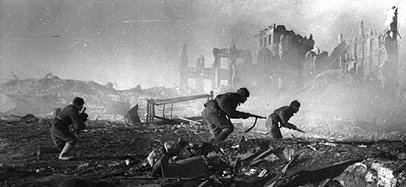
During his exile from Germany during the Second World War, Bertolt Brecht collected photographs. In Sweden, Finland and finally the USA, he cut out and collated a large number of the images of the war that he found in newspapers and magazines. Before long, he had begun to append to these grim relics a series of four-line poems: ironic epigrams aimed not only at the horror of the war itself, but also at its unprecedented restaging as a photographic spectacle. The resulting book, War Primer (1955), is a graphic record of its author’s insight into the new visual lexicon of global warfare. There are aerial photographs of smoking cities; shots of leaders toying with the latest military hardware (Churchill poses with a tommy-gun; Brecht’s caption declares: ‘gang law is something I can understand’); ludicrous propaganda stunts (Hermann Goering cradles his pet lion cub); and a good many more mutilated corpses than most news editors would nowadays countenance. The book is Brecht’s wartime vindication of his late friend Walter Benjamin’s assertion that truth might be best broached by fragmented, alienated, mechanized form. What would a contemporary War Primer look like?
Shot, by Brian Dillon.
Modern Painters [#sept]
 add comment
 The Real World
Tuesday, August 30, 2005, 02:47 PM - Copyfight
The term Real World or real world may mean:
* the stage of life that one enters after completing one's schooling, as in the sentence, "After students enter the real world, they may not be able to sleep late as often as they did while in school."
* a program on MTV in which seven strangers are picked to live in a house for a season and have their lives taped. See The Real World.
* a record label owned by Peter Gabriel that releases world music.
* the world away from the Internet, also known as real life.
* A Real World situation occurs when the reality differs from the theory.
as seen in Answers.com
Back


