
Five Steps to Font Freedom
Monday, May 1, 2006, 03:02 PM - Beautiful Code, Copyfight
Think about these scenarios: You don't need to own a font to read a book set in Goudy. You don't need to own Futura to watch a Wes Anderson film. You don't need to own Times to read the Times. You don't need to own any fonts to watch television. Why not? Because that would be insane. And yet this same logic doesn't apply on the internet. Online, a person needs to own a fully licensed version of a font in order to view it in a web browser. You are reading Arial right now. That's right, Arial. Why? Because everybody on Earth has a licensed version of Arial on their computer. The great democracy of the internet has failed to produce typography any better than the least common denominator of system fonts. As a designer, I hope you are outraged and offended. So what can you do about it?
link
via
 21 comments
 projecting 3D (like you just don't care)
Monday, March 6, 2006, 12:57 PM - Beautiful Code, Games
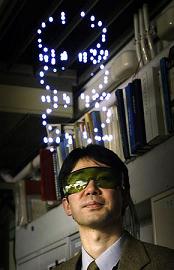 The National Institute of Advanced Industrial Science and Technology (AIST) has built a system that projects 3D images in less that it takes to say 'hollogram'. The device projevts "real 3D images" which consist of dot arrays in space where there is nothing but air.
"Until now, projected three-dimensional imagery has been artificial; optical illusions that appear 3D due to the parallax difference between the eyes of the observer. Prolonged viewing of this conventional sort of 3D imagery can cause physical discomfort. The newly developed device, however, creates real 3D images by using laser light, which is focused through a lens at points in space above the device, to create plasma emissions from the nitrogen and oxygen in the air at the point of focus. Because plasma emission continues for a short period of time, the device is able to create 3D images by moving the point of focus."
link to the project
via dottocomu
Turing's cathedral
Monday, February 27, 2006, 02:42 AM - Beautiful Code, Theory
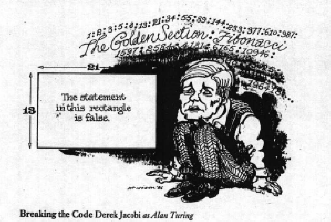
The digital universe was conceived by Old Testament prophets (led by Leibniz) who supplied the logic, and delivered by New Testament prophets (led by von Neumann) who supplied the machines. Alan Turing (1912-1954) formed the bridge between the two.
In a digital computer, the instructions are in the form of COMMAND (ADDRESS) where the address is an exact (either absolute or relative) memory location, a process that translates informally into "DO THIS with what you find HERE and go THERE with the result." Everything depends not only on precise instructions, but on HERE, THERE, and WHEN being exactly defined. It is almost incomprehensible that programs amounting to millions of lines of code, written by teams of hundreds of people, are able to go out into the computational universe and function as well as they do given that one bit in the wrong place (or the wrong time) can bring the process to a halt.
Biology has taken a completely different approach. There is no von Neumann address matrix, just a molecular soup, and the instructions say simply "DO THIS with the next copy of THAT which comes along." The results are far more robust. There is no unforgiving central address authority, and no unforgiving central clock. This ability to take general, organized advantage of local, haphazard processes is exactly the ability that (so far) has distinguished information processing in living organisms from information processing by digital computers.
READ Turing's Cathedral by George Dyson.
The Nature of Code
Saturday, January 21, 2006, 12:27 AM - Beautiful Code
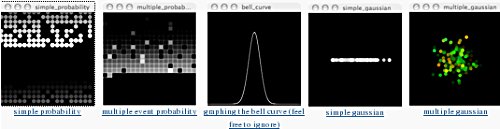
Can we capture the unpredictable evolutionary and emergent properties of nature in software? Can understanding the mathematical principles behind our physical world world help us to create digital worlds? This class will focus on the programming strategies and techniques behind computer simulations of natural systems. We’ll explore topics ranging from basic mathematics and physics concepts to more advanced simulations of complex systems. Subjects covered will include forces, trigonometry, fractals, cellular automata, self-organization, and genetic algorithms. Examples will be demonstrated using Processing with a focus on object oriented programming.
Learn the way of the code with Daniel Shiffman. First week already online!
Blink!
SPOTS media facade berlin
Friday, January 20, 2006, 09:28 PM - Beautiful Code
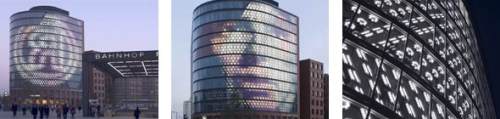
Well, this is one of those things that make this city so desperately awsome isn't it. The SPOTS media facade opened today at 17:00 on the frozen Park Kolonnaden building. As you can see in the pics, a few series of curated art projects will be delivered for free to a hopefully delighted walking audience for 18 months. You can also buy little postcards with changing images on them. The installation was designed by Realities:United, a Berlin-based architecture studio, also responsible for the amazing BIX facade at the Kunsthaus (Graz).
This selection was curated by Andreas Broeckmann, the big man at the Transmediale, but will include works by Jim Campbell, Rafael Lozano-Hemmer, Carsten Nicolai and Realities:United in collaboration with John Dekron. Visitors to Transmediale 06 will have a chance to see them all together, one per day, in a special show.
via generatorx
a terminal everywhere
Friday, January 20, 2006, 09:10 PM - Beautiful Code
Have you ever wanted SSH or telnet access to your system from an "internet desert" - from behind a strict firewall, from an internet cafe, or even from a mobile phone? ANYTERM is a combination of a web page and a web server module that provides this access - see the demos .
Anyterm can use almost any web browser and even works through firewalls. There is experimental support for mobile phones using WAP. If you join my.anyterm.org you can access your systems straight away via our server with no software to install anywhere. Alternatively, you can run the Anyterm software on your own system - see the deployment examples.
anyterm.org
download it!!
Joyce Sequence
Friday, January 20, 2006, 09:02 PM - Beautiful Code
;)
The sequence of numbers
{j_n} giving the number of digits in the three-fold power tower n^(n^n). The values of n^(n^n). for .n==1, 2,. ... are 1, 16, 7625597484987., ... (Sloane's A002488; Rossier 1948), so the Joyce sequence is 1, 2, 13, 155, 2185, 36306., ... (Sloane's A054382). Laisant (1906) found the term j_9., and Uhler (1947) published the logarithm of this number to 250 decimal places (Wells 1986, p. 208).
The sequence is named in honor of the following excerpt from the "Ithaca" chapter of James Joyce's Ulysses:
"Because some years previously in 1886 when occupied with the problem of the quadrature of the circle he had learned of the existence of a number computed to a relative degree of accuracy to be of such magnitude and of so many places, e.g., the 9th power of the 9th power of 9, that, the result having been obtained, 33 closely printed volumes of 1000 pages each of innumerable quires and reams of India paper would have to be requisitioned in order to contain the complete tale of its printed integers of units, tens, hundreds, thousands, tens of thousands, hundreds of thousands, millions, tens of millions, hundreds of millions, billions, the nucleus of the nebula of every digit of every series containing succinctly the potentiality of being raised to the utmost kinetic elaboration of any power of any of its powers."
via (TY Cliff)
Back


