
Copyright has a problem: It's called the Internet.
Sunday, January 22, 2006, 10:57 PM - Copyfight
Protecting stuff comes from fear. Believing that someone is out to take it, raises the question of what led you to the conclusion that whatever it is has such a potential for destroying your way of life? And since you have reached this conclusion, where did the idea come from to put it on the web?
As seen in Gapingvoid, a great rant on Copyright in The Head Lemur
 3 comments
 Hollywood to Google (on video over IP): don't take it away from me!
Saturday, January 21, 2006, 06:21 PM - Copyfight, Media
 Major article from the consultant office i2 Partners War of the Worlds: Hollywood Opts Out of the 'Google Economy':
Hollywood believes large-scale broadband video distribution would only destroy proven value, fail to provide alternative value, and alter a business model that is still far from being in decline. With near-total control of the most valuable program libraries and the business models governing their distribution, a shift towards broadband media will come largely on Hollywood’s terms and at an incremental pace.
Read the article
Download the PDF
TY Damien
The new GPL (beta)
Saturday, January 21, 2006, 06:07 PM - Copyfight
The Free Software Foundation has finally released the draft for the third version of the famous GPL license. As Neco points out there is:
1. This website lists a wdiff -the find-the-seven-differences tool- between the old and the prospective new version.
2. Uwe Hermann also linked a wiki and a comment site where users can give feedback.
3. There is also a rationale document which explains the changes and the contents.
And some more: Linux Pipeline, Proposed GPL Update Open For Business
the apple fairytale of the twice-as-fast Intel chip
Saturday, January 21, 2006, 03:30 PM - Media
DesScorp writes "In Tom Yager's Enterprise Mac column at InfoWorld, he says that "Apple has bought itself another controversy, and once again, needlessly". In a nutshell, he says Apple used multi-processor benchmarks to skew performance comparisons between the new Intel Macs and the PowerPC versions.
Apple uses SPEC*_rate2000 tests as a foundation for claims that Intel-based Macs outperform PowerPC G4 and G5 by a factor of 2 to 5. Well, yeah. A dual-core anything outperforms a single-core anything else by a factor of 2 to 5 in benchmark tests that make use of multiple threads or processes, tests crafted specifically for the purpose of stressing SMP-based systems.
Now please, all at once: dooooodgy...
Root Cause Analysis for Beginners
Saturday, January 21, 2006, 01:38 AM - Howto
A PDF. That is.
Thanks, once again, Adminfoo for making my life so much easier.
The Semantics Differentiation of Minds and Machines
Saturday, January 21, 2006, 12:52 AM - Theory
In Slashdot today:"In Dr David Ellerman's book Intellectual Trespassing as a Way of Life there are a number of interesting essays. But there is one particular essay, entitled "The Semantics Differentiation of Minds and Machines" that caught my attention and which should be of interest to Slashdot readers. In that essay Dr Ellerman claims that "after several decades of debate, a definitive differentiation between minds and machines seems to be emerging into view." In particular, Dr Ellerman argues that the distinction between minds and machines is that while machines (i.e., computers) make excellent symbol manipulation devices, only minds have the additional capacity to ascribe semantics to symbols." Read the rest of John's review.
Isn't that the difference between intelligence and memory? Read the rest of the review by John David Funge
The Nature of Code
Saturday, January 21, 2006, 12:27 AM - Beautiful Code
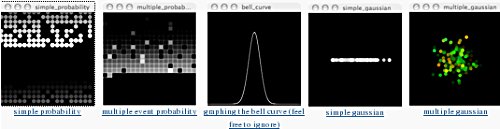
Can we capture the unpredictable evolutionary and emergent properties of nature in software? Can understanding the mathematical principles behind our physical world world help us to create digital worlds? This class will focus on the programming strategies and techniques behind computer simulations of natural systems. We’ll explore topics ranging from basic mathematics and physics concepts to more advanced simulations of complex systems. Subjects covered will include forces, trigonometry, fractals, cellular automata, self-organization, and genetic algorithms. Examples will be demonstrated using Processing with a focus on object oriented programming.
Learn the way of the code with Daniel Shiffman. First week already online!
Blink!
Back Next


